Winter wounds: innovative solutions to improve fish welfare in salmon farming
.png)
In the Norwegian salmon industry, skin wounds – regardless of their underlying cause – remain one of the most significant health and welfare challenges facing farmed fish, according to the latest fish health report from the Norwegian Veterinary Institute. Across all production areas, deaths linked to infectious diseases have increased in recent years, with winter ulcers caused by Moritella viscosa and ulcers from unspecified bacterial infections consistently being main contributors from 2021 to 2024.
Wound diseases can be caused by several different bacterial species. “Classic” winter ulcers are typically associated with M. viscosa, while “atypical” ulcers (or tenacibaculosis) are linked to Tenacibaculum spp.. Adding to this complexity, although M. viscosa and Tenacibaculum spp. are recognised as ulcer-associated pathogens, other bacteria such as Aliivibrio wodanis have also been isolated from wounds and potentially linked to ulcer development. How these bacteria interact and contribute to the onset and progression of disease remains the subject of ongoing research.
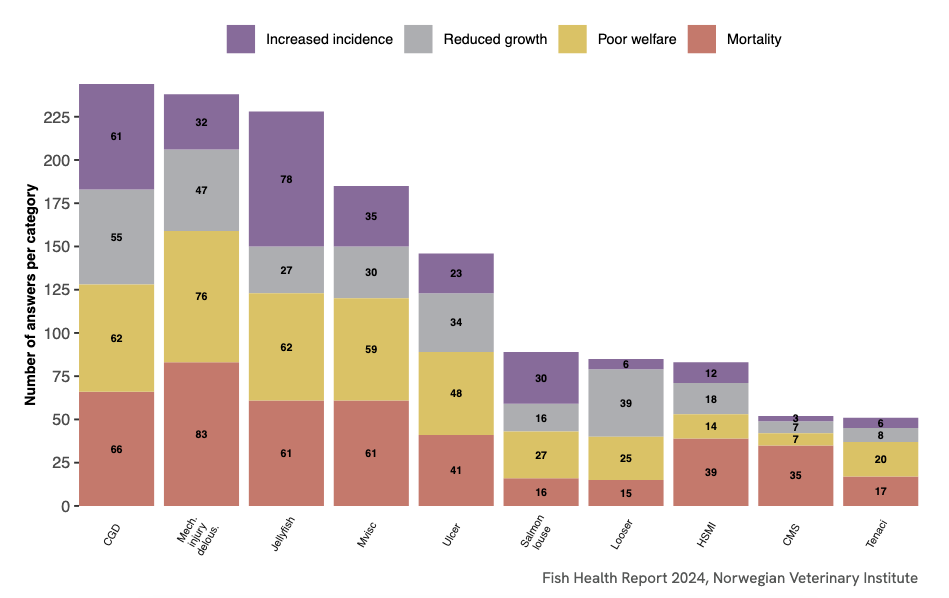
The 10 most important fish health problems of salmon in ongrowing facilities. Categories related to winter wounds include Mvisc (Moritella viscosa infection), Ulcer (skin ulcer, unspecified cause) and Tenaci (Tenacibaculum spp. infection). Source: Fish Health Report 2024, Norwegian Veterinary Institute
On top of this, the industry has reported a strong link between non‑medicinal delousing and subsequent ulcer disease outbreaks. Mechanical delousing and handling cause trauma, stress and elevated infection pressure, with farmers reporting winter ulcer problems two to three weeks after treatment. As a result, the industry faces a growing dilemma : the sector is investing heavily in non‑medicinal delousing to comply with regulations, yet some of the same interventions cause welfare concerns and appear to increase susceptibility to bacterial skin disease
The farmer’s toolbox
While winter ulcer remains a complex and costly challenge, the industry has been and is still working on providing farmers access to a broader toolbox. The industry has moved beyond reactive treatment toward a more preventive, data-driven approach, combining innovative preventive solutions, operational strategies and digital technologies to actively manage risk.
As a starting point, general “best practice” farm management is still seen as an important foundation. High smolt quality, appropriate stocking season and density, and welfare-oriented operations, efficient disease management as well as prioritizing preventive measures against sea lice to minimize reliance on non-medical delousing treatments are all viewed as essential to reduce the impact of winter ulcers.
Vaccination remains the primary preventive measure against classic winter ulcers and is widely regarded as the cornerstone of control strategies. Researchers have documented shifts over time in which M. viscosa types dominate, likely influenced by environmental conditions and the introduction of the first vaccine against M. viscosa. A newly developed Moritella vaccine introduced in 2023 has brought renewed optimism to the industry – and the current winter season will be an important test of whether it can live up to expectations
Bath and water treatments to enhance natural external barriers and reduce infection pressure, including probiotics and bacteriophages, have shown interesting case-based results.
All major feed companies offer products targeting skin protection, wound healing, and bacterial control. These functional feeds deliver immune modulators that support mucus function in the skin and gills. While lab and early field data are promising, farmers remain skeptical about their real-world cost–benefit, especially when used alongside other expensive interventions.
AI to monitor outbreaks
On the monitoring side, technology is moving faster than adoption. Smart camera systems with machine vision can already detect and score wounds on individual fish, reducing the need for manual handling – a major benefit given the stress handling can cause – while providing a far more granular welfare picture at cage level. Despite this, survey data from Norway suggest that still a comparatively small fraction of the industry use camera-based welfare scoring extensively.
Beyond cameras, predictive analytics and decision‑support platforms can integrate environmental, welfare and production data to forecast risk and evaluate the impact of different interventions over time. In parallel, novel diagnostic approaches – from genotyping of M. viscosa sub‑populations to non‑lethal, blood‑based biomarker panels – are emerging to help farmers detect issues earlier and tailor responses more precisely.
Proactive diagnostics and digital tools are only likely to scale if farmers can clearly see how earlier information connects to practical options at farm level and measurable economic returns. Without that line of sight, “more data” risks being perceived as just another cost.
Future directions for tackling winter wounds
Looking ahead, winter wounds are unlikely to be “solved” by a single tool. Progress will depend on how well farms combine preventive management, vaccination and smarter monitoring into strategies that work under real-world conditions. With recent cold winters, ulcer risk is something salmon farmers will likely need to watch closely.
The upcoming annual fish health from the Norwegian Veterinary Institute will show how ulcer-related and other bacterial diseases are developing, offering valuable insights for understanding salmon welfare in Norwegian farming. We’ll be keeping a close eye on the findings as they emerge.
Inken Tiedemann, Project Manager Hatch Blue - 26 January 2026
Related Posts
Where Is Capital Flowing in Norway’s Salmon Farming Landscape?
Maine: A Natural Hub for Blue Biotechnology
Canada's First Aquaculture Studio: What We Learned